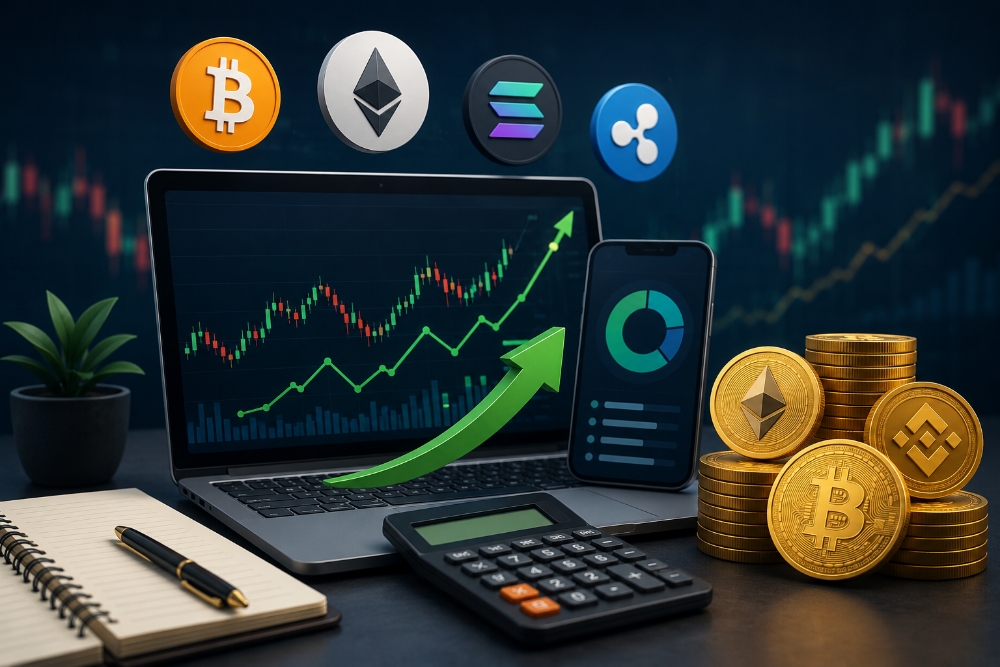
WHILE YOU WERE WATCHING THE PRICE, INSTITUTIONS WERE BUILDING AN EMPIRE"

While most retail traders were refreshing their portfolios and doomscrolling through Twitter, something extraordinary was happening beneath the surface. The institutions weren't just buying — they were building the financial infrastructure of the future.
In the past few weeks alone, we've seen Japan's largest financial group choose Solana to power its entire on-chain economy. We've seen Bitcoin ETFs post their longest inflow streak of 2026. We've seen the US State Department officially bring Bitcoin advocates to the foreign policy table.
And yet, the Fear & Greed Index still hovers near "Extreme Fear."
This is the gap that separates the winners from the losers. The institutions are building. The retail crowd is panicking. And the wealth transfer is happening in real time.
Here's what you need to know.
---
### 🇯🇵 JAPAN'S FINANCIAL SYSTEM IS MOVING TO SOLANA
On July 13, 2026, SBI Holdings — one of Japan's largest financial groups — and the Solana Foundation announced a strategic partnership to build regulated on-chain markets for stablecoins and tokenized assets[reference:0]. The joint venture, SBI Solana Global, will issue JPY-denominated stablecoins, tokenize real-world assets such as bonds and real estate, and build cross-border payment rails for institutional clients[reference:1][reference:2].
This isn't a pilot program. This isn't a "we're exploring" statement. This is Japan's financial establishment saying: "Solana is the infrastructure we trust."
The partnership gives Solana one of its strongest institutional partnerships in Asia[reference:3]. And it's not happening in a vacuum. SBI's subsidiary B2C2 named Solana as a primary rail for stablecoin settlement back in April 2026, signaling the group had already tested the chain before this broader commitment[reference:4].
But there's more. On July 8, 2026, Alvarez & Marsal — a leading global professional services firm — processed its first USDC payment on the Solana blockchain[reference:5]. The Head of Institutional Growth at the Solana Foundation called it "another milestone for professional services and institutional finance more broadly"[reference:6].
The message is clear: Solana is no longer just a retail blockchain. It's becoming the settlement layer for institutional finance.
---
### 📈 BITCOIN ETFs: THE LONGEST INFLOW STREAK OF 2026
While Japan was making history with Solana, something else was happening in the US markets.
Between July 14 and July 22, US spot Bitcoin ETFs recorded net inflows for seven consecutive trading sessions, totalling approximately $999.38 million[reference:7]. That is the longest and largest inflow run of 2026[reference:8].
Let me put that in perspective. June 2026 alone saw $4.7 billion in outflows from Bitcoin ETFs — the largest monthly exodus since these products came to market[reference:9]. An eight-week outflow streak had pulled more than $8.2 billion out of the complex[reference:10].
The selling has now not just stopped but reversed for seven consecutive sessions.
On July 22 alone, spot Bitcoin ETFs saw net inflows of $69 million, with BlackRock's iShares Bitcoin Trust (IBIT) contributing the most[reference:11]. BlackRock's IBIT has been one of the primary sources of capital throughout this recovery[reference:12].
Total net assets across the complex have recovered to $80.9 billion, up from $74.37 billion at the start of July[reference:13]. Cumulative net inflows since the products launched now stand at $51.8 billion[reference:14].
Bitcoin traded as high as $66,300 during the streak and sat near $65,500 on Thursday, having rallied more than 13% from a July 1 low of $57,750[reference:15].
But here's what makes it even more remarkable: the macro backdrop against which it happened. Brent crude crossed $100 on Thursday after Houthi forces struck Saudi tankers in the Red Sea. The US 10-year Treasury yield sat at 4.695%, the highest since January 2025. September Fed hike odds firmed near 78%.
Institutional money bought Bitcoin ETFs every session through all of it.
---
### 🏛️ THE STATE DEPARTMENT EMBRACES BITCOIN
On July 24, 2026, the US State Department officially named the Bitcoin Policy Institute (BPI) as a founding partner in its new diplomatic initiative — the Freedom Tech Excellence Program (FTEP).
The State Department is partnering with BPI alongside defense giants Palantir Technologies and Anduril Industries. The program places private-sector professionals into temporary roles within the State Department to assist with projects involving digital freedom and new technologies.
Let that sink in. The US government is officially bringing Bitcoin advocates to the foreign policy table.
Washington is acknowledging that Bitcoin-related knowledge belongs in national security and international diplomacy debates. This is a signal that Bitcoin's role in global geopolitics is no longer theoretical — it's operational.
---
### 🛡️ STRATEGY AND BLACKROCK PLEDGE $15 MILLION TO SECURE BITCOIN
On July 23, 2026, a consortium led by Strategy (formerly MicroStrategy) and BlackRock pledged an aggregate $15 million over the next three years to support developers securing the Bitcoin network against the threat of a quantum computing breakthrough[reference:16].
This is not a small commitment. The fact that Strategy and BlackRock — two of the largest Bitcoin holders in the world — are jointly funding quantum resistance research shows they are thinking decades ahead. They are not worried about next week's price. They are worried about Bitcoin's long-term viability.
And they are putting their money where their mouth is.
---
### 📊 SOLANA'S RWA EXPLOSION: THE NUMBERS ARE STAGGERING
Let's talk about the numbers that should be making headlines but aren't.
Solana's on-chain RWA market grew from $873 million in January to $3.62 billion by July — a 315% increase in six months[reference:17]. The network's 30-day RWA transfer volume reached $8.68 billion as of July 6, up 105.76% from 30 days earlier[reference:18][reference:19].
Solana now accounts for approximately 95% of all on-chain tokenized equity trading[reference:20]. The network processed $5.77 billion in tokenized asset spot volume during Q2 2026 — a quarterly record across ALL chains[reference:21].
Solana has surpassed 300,000 unique RWA holders — more than any other blockchain[reference:22]. While Ethereum still holds more total value at $15.9 billion, that lead is shrinking fast[reference:23].
The infrastructure is being built. The volume is real. The adoption is accelerating.
---
### 📉 THE OTHER SIDE OF THE COIN
Of course, I wouldn't be doing my job if I didn't show you the full picture.
While the seven-day inflow streak is impressive, the yearly picture remains weaker. US spot funds carried about $4.84 billion in net outflows during 2026[reference:24].
And there are real headwinds. The Clarity Act — the bipartisan bill designed to establish regulatory boundaries between the SEC and CFTC — is facing hurdles. Senate Democrats say the ethics and anti-money-laundering provisions remain inadequate[reference:25]. Galaxy Research head Alex Thorn lowered his estimate for the Clarity Act passing in 2026 to about 30%.
JPMorgan analysts have also warned that the rise of private chain and permissioned blockchain adoption by institutions poses a greater risk to Bitcoin than Strategy's holdings[reference:26]. The report challenges the assumption that mainstream blockchain use will necessarily benefit public chains and their native tokens[reference:27].
These are real risks. But they are not reasons to panic — they are reasons to pay attention.
---
### 💎 WHAT THIS MEANS FOR YOU
1. Japan's largest financial group is moving its entire on-chain economy to Solana. This is not a test. This is happening now.
2. Bitcoin ETFs just recorded their longest inflow streak of 2026 — nearly $1 billion in seven days. Institutional capital is returning.
3. The US State Department is officially bringing Bitcoin advocates to the foreign policy table. Bitcoin's strategic importance is being recognized at the highest levels of government.
4. Strategy and BlackRock are jointly funding quantum resistance research for Bitcoin. They are thinking decades ahead.
5. Solana's RWA market grew 315% in six months and now processes 95% of all tokenized equity trading. The infrastructure is being built.
6. The Clarity Act faces hurdles, and JPMorgan has raised legitimate concerns about private chains. These are risks — but they are also opportunities for those who understand them.
---
### 🚀 MY TAKE
I am not a financial advisor, but here's what I see: Japan's financial establishment choosing Solana is not an accident. Seven consecutive days of ETF inflows during an oil shock is not random. The State Department partnering with a Bitcoin advocacy group is not a coincidence. Strategy and BlackRock funding quantum resistance research is not a PR stunt.
These are structural shifts.
The financial system is being rebuilt on blockchain infrastructure. Wall Street is integrating Bitcoin. Governments are acknowledging Bitcoin's strategic importance. Solana is becoming the settlement layer for institutional finance.
The gap between what institutions are doing and what retail sentiment reflects has never been wider. While retail traders panic over short-term price movements, institutions are building the foundation for the next decade.
The question is not whether this transformation will happen. It's whether you will be positioned when it does.
---
What's YOUR take? Are you paying attention to the institutional build — or just the price? Drop your thoughts in the comments! 👇
---
#Bitcoin #Solana #SBI #StateDepartment #InstitutionalInvesting #ETF #RWA #Tokenization #Write2Earn #CryptoJourney #BTC #DigitalAssets #FinancialFreedom